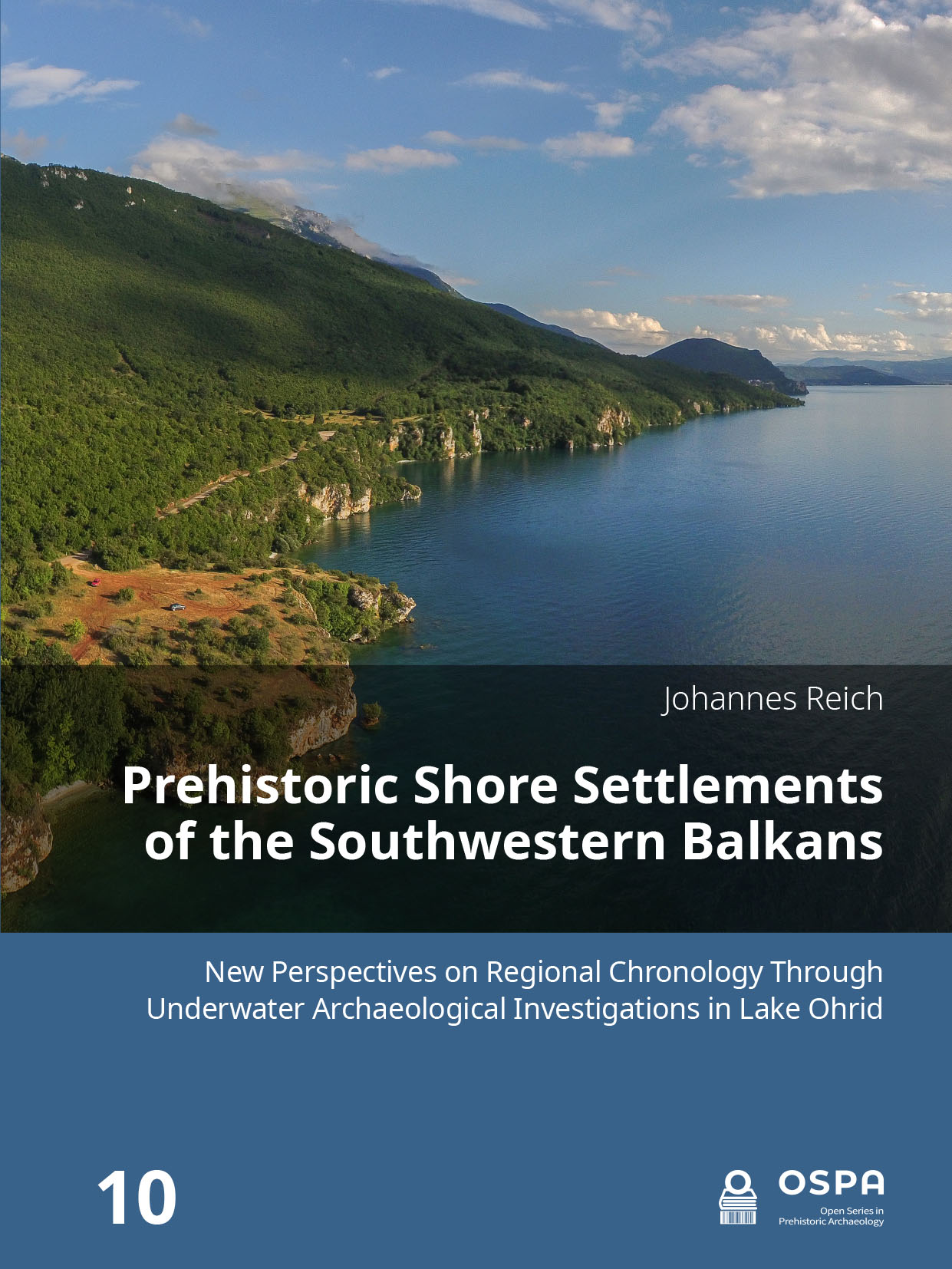
Prehistoric Shore Settlements of the Southwestern Balkans

New Perspectives on Regional Chronology Through Underwater Archaeological Investigations in Lake Ohrid

Johannes Reich | Forthcoming

Prehistoric Shore Settlements of the Southwestern Balkans

New Perspectives on Regional Chronology Through Underwater Archaeological Investigations in Lake Ohrid

Johannes Reich | Forthcoming


Paperback ISBN: 9789464281446 | Hardback ISBN: 9789464281453 | Imprint: Sidestone Press Dissertations | Format: 210x280mm | ca. 270 pp. | Open Series in Prehistoric Archaeology 10 | Series: OSPA: Open Series in Prehistoric Archaeology | Language: English | 42 illus. (bw) | 139 illus. (fc) | Keywords: prehistoric archaeology; underwater archaeology; shore settlements; pile-dwellings; chronology; neolithic; bronze age; Balkans | download cover | DOI: 10.59641/t0w6q7r8s9 | CC-license: CC BY-NC 4.0

Publication date: 25-02-2027

We will plant a tree for each order containing a paperback or hardback book via OneTreePlanted.org.

This publication presents the first cross-border synthesis of data on prehistoric shore settlement sites in the southwestern Balkans.
Archaeological settlement sites, located along lakeshores, rivers, and wetlands, are among the richest sources for prehistoric periods due to their exceptional waterlogged preservation. The preservation of wooden construction elements enables the application of dendrochronology and radiocarbon dating, allowing settlement histories to be reconstructed with high temporal precision.

The core of this publication comprises the results of underwater archaeological excavations at Ploča Mičov Grad (North Macedonia), including the associated find assemblage and a pile field analysis; preliminary results from Lin 3 (Albania); and a comprehensive catalogue of all currently known prehistoric shore settlement sites in the tri-border region of Albania, Greece, and North Macedonia. Within this context, the potential of these sites to establish an absolute chronological reference framework is assessed through new data and reanalysis of previously published material.

Ploča Mičov Grad provides the first instance in which a well-dated settlement phase (45th/44th century BC) can be directly linked to a fully documented find assemblage. By systematically combining absolute chronological and archaeological data, this study demonstrates the significant potential of shore settlement sites to establish a robust chronological reference framework for the region – one capable of replacing previously incompatible chronologies and significantly advancing our understanding of cultural processes in prehistoric southeastern Europe.

Acknowledgments

1 Introduction
1.1 Objectives
1.2 Research Historical Context
1.3 Chronology – Starting Point

2 Natural Environment
2.1 Topography
2.2 Hydrology
2.3 Climate and Vegetation
2.3.1 Holocene Paleovegetation and Early Land Use

3 Methodological Foundations
3.1 Excavation Techniques Underwater
3.1.1 Pile Field Documentation
3.1.2 Stratigraphic Excavation
3.1.3 Diving Material
3.2 Surveying
3.2.1 Geodetic Surveying
3.2.2 SfM-Based Pile Field Documentation
3.3 Scientific Dating
3.3.1 Dendrochronology
3.3.2 Radiocarbon Dating

4 Catalogue of Shore Settlement Sites
4.1 Albania
4.1.1 Lake Ohrid
4.1.2 Great Prespa Lake
4.1.3 Korça Basin
4.2 Greece
4.2.1 Amindeon Basin
4.2.2 Great Prespa Lake
4.2.3 Lake Kastoria
4.3 North Macedonia
4.3.1 Lake Ohrid (and Black Drin)
4.3.2 Great Prespa Lake

5 Ploča Mičov Grad
5.1 Location
5.2 Research History
5.3 Fieldwork 2017–2019
5.3.1 Objectives 2018 and 2019
5.3.2 Procedure 2018 and 2019
5.4 Features
5.4.1 Pile Field Analysis
5.4.2 Stratigraphy
5.4.3 Synthesis of Dating and Stratigraphy
5.5 Finds
5.5.1 Field 2: Vessel Ceramics
5.5.2 Field 2: Other Ceramics
5.5.3 Field 2: Stone Artefacts
5.5.4 Field 2: Bronze
5.5.5 Field 2: Wood and Bone Artefacts
5.5.6 Field 1
5.5.7 Comparisons in the Study Area

6 Synthesis
6.1 Preservation Condition of Shore Settlement Sites
6.2 Current State of Absolute Chronology
6.3 First Reference Assemblages for Chronological Classification of Material Culture

7 Summary/Zusammenfassung
7.1 Summary
7.2 Zusammenfassung

8 Online Appendix

9 References

10 Catalogue of Finds
10.1 Ploča Mičov Grad, Field 2 and Selection of Field 1
10.2 Lin 3, Fields 1–3: Selection of Ceramics

11 Plates

Dr. Johannes Reich

Johannes Reich studied Prehistoric and Provincial Roman Archaeology at the Universities of Bern and Kiel and received his PhD from the University of Bern. His doctoral research was conducted within the ERC Synergy project EXPLO (Exploring the Dynamics and Causes of Prehistoric Land Use Change in the Cradle of European Farming) and focused on prehistoric shore settlements in the southwestern Balkans. He is currently a scientific collaborator and scientific diver at the Archaeological Service of the Canton of Bern. His research interests include prehistoric shore settlements, chronology, underwater archaeology and digital documentation methods. He has carried out underwater archaeological fieldwork in Switzerland, North Macedonia and Albania and has contributed to research on prehistoric settlement chronologies and the investigation of waterlogged archaeological sites.

read more

Reich, J. (in press). Prehistoric Shore Settlements of the Southwestern Balkans. New Perspectives on Regional Chronology Through Underwater Archaeological Investigations in Lake Ohrid. Open Series in Prehistoric Archaeology 10. Sidestone Press. https://doi.org/10.59641/t0w6q7r8s9

Abstract:

This publication presents the first cross-border synthesis of data on prehistoric shore settlement sites in the southwestern Balkans.
Archaeological settlement sites, located along lakeshores, rivers, and wetlands, are among the richest sources for prehistoric periods due to their exceptional waterlogged preservation. The preservation of wooden construction elements enables the application of dendrochronology and radiocarbon dating, allowing settlement histories to be reconstructed with high temporal precision.

The core of this publication comprises the results of underwater archaeological excavations at Ploča Mičov Grad (North Macedonia), including the associated find assemblage and a pile field analysis; preliminary results from Lin 3 (Albania); and a comprehensive catalogue of all currently known prehistoric shore settlement sites in the tri-border region of Albania, Greece, and North Macedonia. Within this context, the potential of these sites to establish an absolute chronological reference framework is assessed through new data and reanalysis of previously published material.

Ploča Mičov Grad provides the first instance in which a well-dated settlement phase (45th/44th century BC) can be directly linked to a fully documented find assemblage. By systematically combining absolute chronological and archaeological data, this study demonstrates the significant potential of shore settlement sites to establish a robust chronological reference framework for the region – one capable of replacing previously incompatible chronologies and significantly advancing our understanding of cultural processes in prehistoric southeastern Europe.

Contents

Acknowledgments

1 Introduction
1.1 Objectives
1.2 Research Historical Context
1.3 Chronology – Starting Point

2 Natural Environment
2.1 Topography
2.2 Hydrology
2.3 Climate and Vegetation
2.3.1 Holocene Paleovegetation and Early Land Use

3 Methodological Foundations
3.1 Excavation Techniques Underwater
3.1.1 Pile Field Documentation
3.1.2 Stratigraphic Excavation
3.1.3 Diving Material
3.2 Surveying
3.2.1 Geodetic Surveying
3.2.2 SfM-Based Pile Field Documentation
3.3 Scientific Dating
3.3.1 Dendrochronology
3.3.2 Radiocarbon Dating

4 Catalogue of Shore Settlement Sites
4.1 Albania
4.1.1 Lake Ohrid
4.1.2 Great Prespa Lake
4.1.3 Korça Basin
4.2 Greece
4.2.1 Amindeon Basin
4.2.2 Great Prespa Lake
4.2.3 Lake Kastoria
4.3 North Macedonia
4.3.1 Lake Ohrid (and Black Drin)
4.3.2 Great Prespa Lake

5 Ploča Mičov Grad
5.1 Location
5.2 Research History
5.3 Fieldwork 2017–2019
5.3.1 Objectives 2018 and 2019
5.3.2 Procedure 2018 and 2019
5.4 Features
5.4.1 Pile Field Analysis
5.4.2 Stratigraphy
5.4.3 Synthesis of Dating and Stratigraphy
5.5 Finds
5.5.1 Field 2: Vessel Ceramics
5.5.2 Field 2: Other Ceramics
5.5.3 Field 2: Stone Artefacts
5.5.4 Field 2: Bronze
5.5.5 Field 2: Wood and Bone Artefacts
5.5.6 Field 1
5.5.7 Comparisons in the Study Area

6 Synthesis
6.1 Preservation Condition of Shore Settlement Sites
6.2 Current State of Absolute Chronology
6.3 First Reference Assemblages for Chronological Classification of Material Culture

7 Summary/Zusammenfassung
7.1 Summary
7.2 Zusammenfassung

8 Online Appendix

9 References

10 Catalogue of Finds
10.1 Ploča Mičov Grad, Field 2 and Selection of Field 1
10.2 Lin 3, Fields 1–3: Selection of Ceramics

11 Plates

Dr. Johannes Reich

Johannes Reich studied Prehistoric and Provincial Roman Archaeology at the Universities of Bern and Kiel and received his PhD from the University of Bern. His doctoral research was conducted within the ERC Synergy project EXPLO (Exploring the Dynamics and Causes of Prehistoric Land Use Change in the Cradle of European Farming) and focused on prehistoric shore settlements in the southwestern Balkans. He is currently a scientific collaborator and scientific diver at the Archaeological Service of the Canton of Bern. His research interests include prehistoric shore settlements, chronology, underwater archaeology and digital documentation methods. He has carried out underwater archaeological fieldwork in Switzerland, North Macedonia and Albania and has contributed to research on prehistoric settlement chronologies and the investigation of waterlogged archaeological sites.

read more



We will plant a tree for each order containing a paperback or hardback book via OneTreePlanted.org.

You might also like:


© 2026 Sidestone Press      KvK nr. 28114891           Privacy policy     Sidestone Newsletter     Terms and Conditions (Dutch)