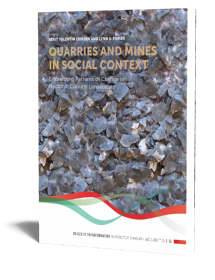
Abstract:
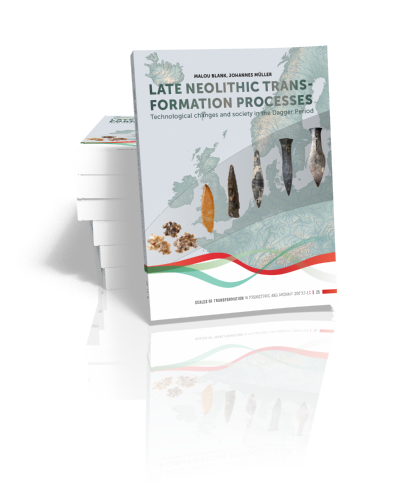
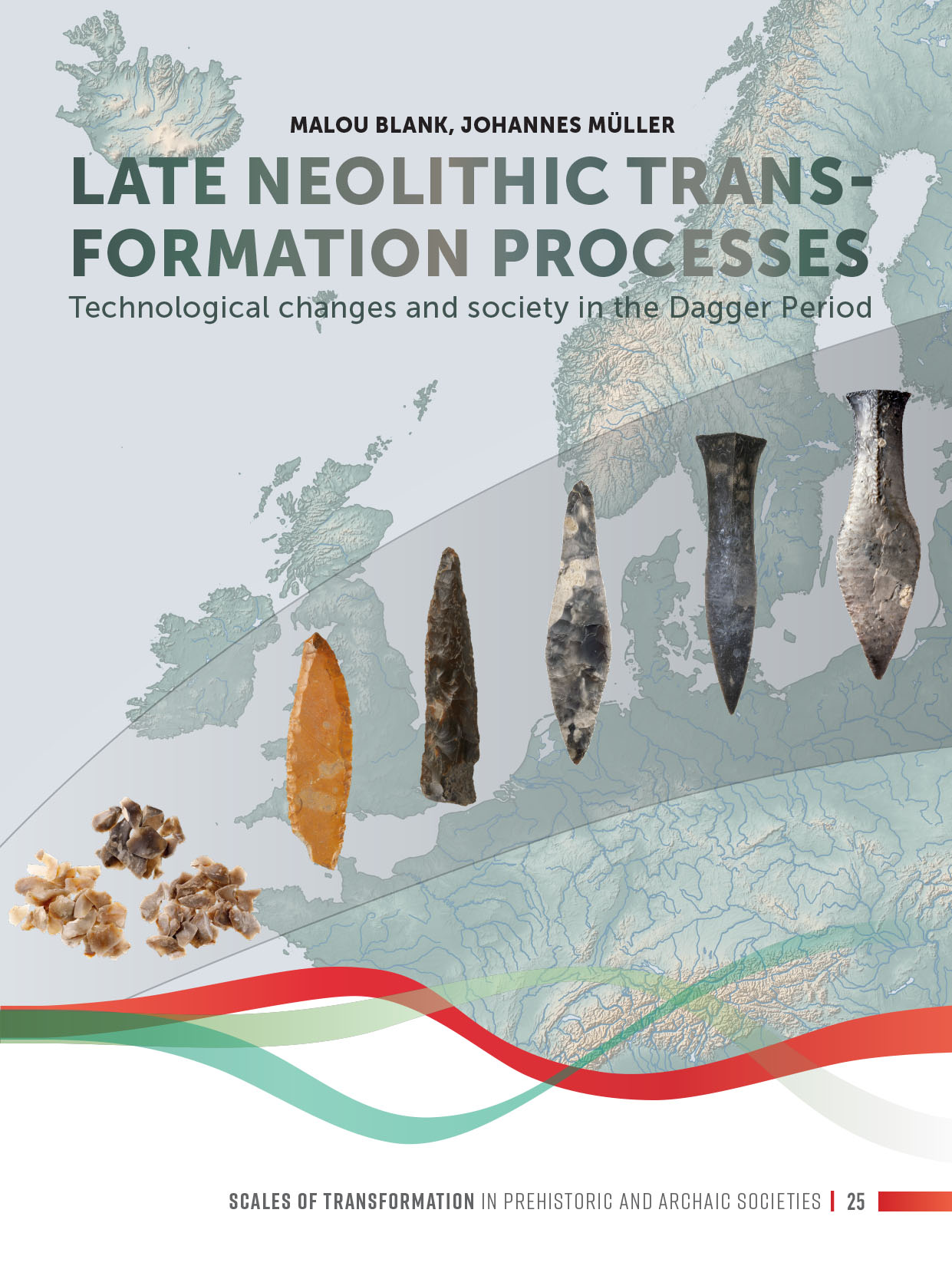
Around 2200–1700 BCE, Scandinavia and Central Europe were shaped by significant socio-environmental transformations. Between central Germany and northern Norway, Nordic flint daggers symbolise these changes—across different societies and under varying environmental conditions.
For the first time, this book brings together and interprets both Central European and Scandinavian contributions on this subject. It becomes evident that a wave of innovation transformed the world: flint daggers and flint sickles, new agricultural techniques, and changes in domestic architecture all reflect a new habitus. This new way of life emerged during a period of climate change and had an impact across hundreds of kilometres, affecting an entire subcontinent.
Contents
The Late Neolithic enigma: an introduction
Malou Blank, Johannes Müller
Dagger maps and reflections on the development of core daggers
Sebastian Schultrich, Barbara Fritsch, Jonas Beran, Knut Rassmann, Moritz Mennenga, Johannes Müller
Reneolithisation – Subsistence and the process towards cultural, economic and genetic homogeneity in Late Neolithic southern Scandinavia
Jens Winther Johannsen
From lithics to bronze: spatial, temporal, and contextual insights into Late Neolithic and earliest Bronze Age artefacts and assemblages in south-east Norway
Anette Sand-Eriksen, Steinar Solheim
Daggers and gallery graves. The Late Neolithic in inland south-western Sweden
Malou Blank
The Late Neolithic passage grave people of eastern Denmark and southernmost Sweden: radiocarbon insights
Anna Tornberg
Similarities, differences and supra-regional relations during the Late Neolithic of the southern Cimbrian peninsula
Sebastian Schultrich
Lost in transition? The change in burial rites from the Late Neolithic to the Early Bronze Age
Stefanie Schaefer-Di Maida
Not just a pile of stones! A unique Young / Late Neolithic feature on the southern North Sea coast
Moritz Mennenga, Anja Behrens, Steffen Wolters, Annette Siegmüller, Martina Karle
Bargen and daggers
Sebastian Schultrich
Time and Place. Disentangling the chronology of flint dagger and sickles in the Late Neolithic of north-eastern Germany
Hendrik Raese
The phenomenon of flint daggers in Western Pomerania in the context of the latest research on the transition between the Neolithic and Bronze Age in the Lower Oder region
Agnieszka Matuszewska, Dorota Kozłowska, Krzysztof Kowalski, Janusz Czebreszuk
Identifying flint knappers’ decisions — and then?
Moiken Hinrichs
Flint Daggers in Saxony-Anhalt: State of research and material collection. First approaches and ideas
Jonas Beran and Barbara Fritsch
Late Neolithic Ecology and Plant Economy in the south-western Baltic region (2200–1800 BCE)
Wiebke Kirleis, Ingo Feeser, Dragana Filipović, Johannes Müller
The Nordic Late Neolithic: constructing connected diversities of a boom phase
Johannes Müller, Malou Blank

Dr.
Malou Blank
Malou Blank is a researcher based at the University of Gothenburg, Sweden, where she completed her PhD in archaeology (2021). Her main research interests are gallery graves and the Nordic Late Neolithic period. She has been involved in a number of research projects and fieldwork focusing on Neolithic and Early Bronze age societies. Her research includes studies of megalithic graves, mobility, diet, subsistence, flint daggers, and pottery and copper provenience.
read more
Prof. dr.
Johannes Müller
Johannes Müller (PhD, University of Freiburg, 1990) is a Professor and Director of the Institute for Prehistoric and Protohistoric Archaeology at Kiel University, Germany. He is the founding director of the Johanna Mestorf Academy, Speaker of the Collaborative Research Centre “Scales of Transformation: Human-environmental Interaction in Prehistoric and Archaic Societies” and of the Excellence Cluster “ROOTS – Social, Environmental, and Cultural Connectivity in Past Societies”.
read more