


Unforeseeable Futures
Confronting Crises in the Archaeology of Highland Societies
Edited by Susan Pollock, Reinhard Bernbeck, Gisela Eberhardt, and Martin Kehl | 2026
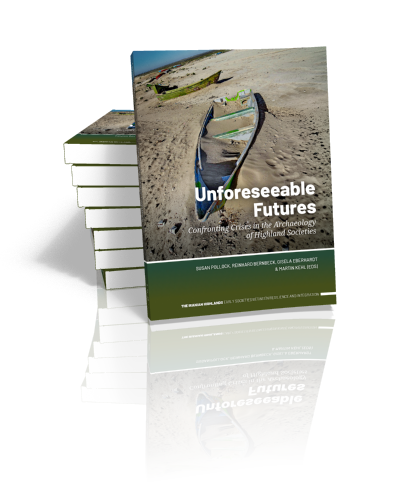
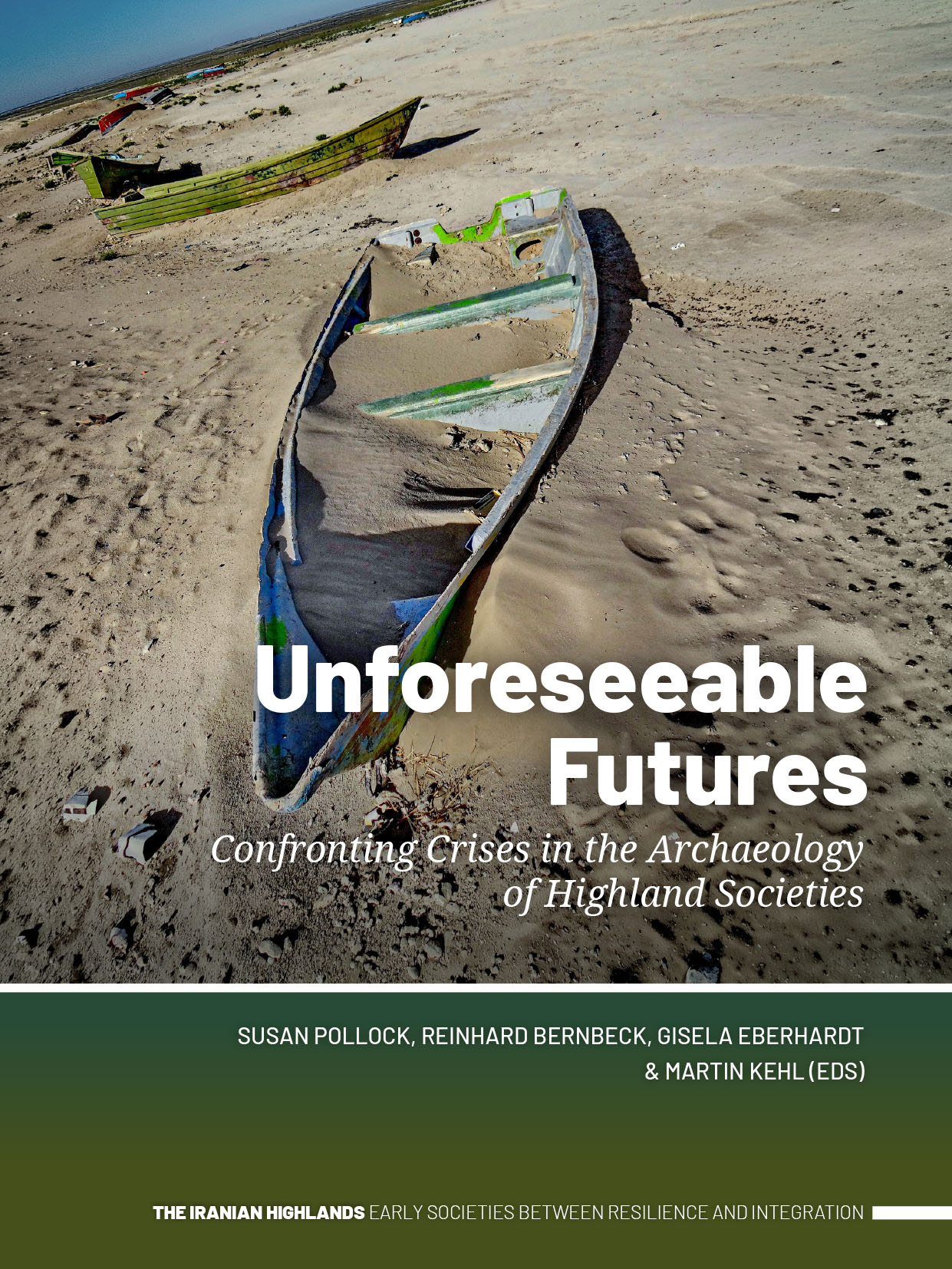
Unforeseeable Futures
Confronting Crises in the Archaeology of Highland Societies
Edited by Susan Pollock, Reinhard Bernbeck, Gisela Eberhardt, and Martin Kehl | 2026
Paperback ISBN: 9789464271713 | Hardback ISBN: 9789464271720 | Imprint: Sidestone Press Academics | Format: 210x280mm | 228 pp. | The Iranian Highlands. Early Societies between Resilience and Integration 5 | Language: English | 19 illus. (bw) | 63 illus. (fc) | Keywords: crisis in archaeology; crisis factors; coping with crisis; highland societies; resilience; climate change; migration | download cover | DOI: 10.59641/y3b9v0w1x2 | CC-license: CC BY 4.0
Read online 7 times
- Digital & Online access
-
Buy via Sidestone (EU & UK)
-
Buy via our Distributors (WORLD)
For non-EU or UK destinations you can buy our books via our international distributors. Although prices may vary this will ensure speedy delivery and reduction in shipping costs or import tax. But you can also order with us directly via the module above.
UK international distributor
USA international distributor
-
Bookinfo
Paperback ISBN: 9789464271713 | Hardback ISBN: 9789464271720 | Imprint: Sidestone Press Academics | Format: 210x280mm | 228 pp. | The Iranian Highlands. Early Societies between Resilience and Integration 5 | Language: English | 19 illus. (bw) | 63 illus. (fc) | Keywords: crisis in archaeology; crisis factors; coping with crisis; highland societies; resilience; climate change; migration | download cover | DOI: 10.59641/y3b9v0w1x2 | CC-license: CC BY 4.0
Read online 7 times

We will plant a tree for each order containing a paperback or hardback book via OneTreePlanted.org.
Despite their apparent ubiquity today, archaeologists have seldom focused explicitly on crises. The authors in this book take up the challenge of doing so, drawing on archaeological cases from a wide temporal and spatial range. In addition to identifying crises, the contributions search for the factors that underlie them. These range from climate to disease, environmental destruction, sudden natural events such as volcanic eruptions, and intra- or intersocietal conflicts.
Factors are often intertwined in complex ways that lead to emergent properties and that can neither be attributable solely to anthropogenic nor to natural causes. Coping with crises include rearrangements of ways of life, such as increasing or decreasing mobility, the use of alternative (‘second-choice’) food sources, recourse to intensified or newly developed rituals, demise of old institutions and/or the building of new ones, and small-scale acts of subversion.
This book is the fifth volume of a series published by the German-Iranian research cooperation “The Iranian Highlands: Resiliences and Integration in Premodern Societies”. The goal of the research project is to shine a new light on communities and societies that populated the Iranian highlands and their more or less successful strategies to cope with the many vagaries, the constant changes and risks of their natural and humanly shaped environments.
Crises – An Introduction
Reinhard Bernbeck, Susan Pollock, and Martin Kehl
Characterising crises
Crises of Our Own Making: Finding a Way Out of the Resilience Myth for Archaeology
Matthew C. Reilly
Are Archaeologists Crisis-philic? Exploring the Nexus of Climate Change and Migration
Sepideh Maziar
Politics, religion, and crises
How did the Elamites Cope with Crises? Looking at the Gap between the Middle and the Neo-Elamite Period
Rafiei-Alavi
Is This Burning an Eternal Flame? Political Crises and Dynastic Cults in Southwest Asia during Antiquity
Michael Brown
Death at the beginning of life. Medieval and early modern infant burial as response to multiple crises and what we can learn from it today
Barbara Hausmair
Environment and Crises
Climate and Crises: Towards an Eventful and Punctuated Prehistory
Felix Riede
Dehqaed’s Natural Crises and the Challenge of Flooding
Zohreh Zehbari
Fending off Crises with Porosity: Sand, Water and Wind in the Helmand Basin
Moslem Mishmastnehi and Reinhard Bernbeck
Resources, technology, and crisis
Probing Criticality: Sliding Scales of Crisis in Two Highland Societies
Reinhard Bernbeck, Susan Pollock, and Jana Eger
On the Edge of Crisis – A View from Archaeometry
Kristina A Franke
Metal and Crisis: Crisis Phenomena in the Production, Distribution and Utilisation of Copper and Other Metals Between the 4th and the Late 2nd Millennium BCE in West Asia
Thomas Stöllner
No Risk, No Neolithisation
Judith Thomalsky and Akbar Abedi
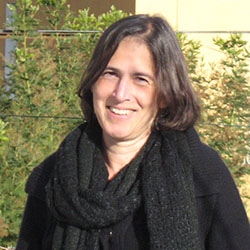
Prof. dr. Susan Pollock
Susan Pollock held positions as professor of Western Asian Archaeology at the Freie Universität Berlin and professor of Anthropology at Binghamton University. She has long-standing research interests in village, early state, and urban societies in Western Asia and has conducted fieldwork in Iraq, Iran, Turkey, and Turkmenistan. She also researches more recent periods and has worked on sites of the 20th century in and around Berlin. Her research draws on feminist and political economic approaches to the study of the past, with specific attention to processes of subjectivation and the place of commensality in social life.

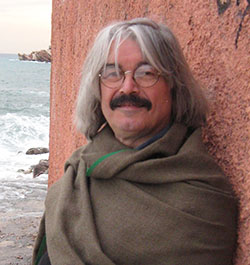
Prof. dr. Reinhard Bernbeck
Reinhard Bernbeck is Professor i.R. of Western Asian archaeology at the Freie Universität Berlin and professor emeritus of Anthropology at Binghamton University. His interests include the prehistory of Iran, archaeological manifestations of repression, exploitation and suffering, and ideological dimensions of archaeological practice. He has carried out fieldwork in Iran, Iraq, Syria, Jordan, Turkey, and Turkmenistan. He has also investigated several prisoner-of-war and forced labor camps from the 20th century in Germany.
Prof. Dr. Martin Kehl
Martin Kehl is Professor of Physical Geography at the University of Koblenz and studies the significance of climate and humans for landscape evolution as well as the effects of environmental changes on pre-modern societies. He investigates sedimentary archives of past environmental change and human adaptation including soils, loess, lake sediments and anthropogenic deposits. His research focuses on the Late Quaternary and Iran.
Dr. Gisela Eberhardt
Gisela Eberhardt is a project manager for the joint research project “The Iranian Highlands. Resiliences and Integration in Premodern Societies” at Freie Universität Berlin and an editor in the editorial department at the German Archaeological Institute’s (DAI) head office. She holds a PhD in archaeology from Humboldt-Universität zu Berlin and was one of the managing editors of Edition Topoi.
Pollock, S., Bernbeck, R., Eberhardt, G., & Kehl, M. (Eds.). (2026). Unforeseeable Futures. Confronting Crises in the Archaeology of Highland Societies. The Iranian Highlands. Early Societies between Resilience and Integration 5. Sidestone Press. https://doi.org/10.59641/y3b9v0w1x2
Abstract:
Despite their apparent ubiquity today, archaeologists have seldom focused explicitly on crises. The authors in this book take up the challenge of doing so, drawing on archaeological cases from a wide temporal and spatial range. In addition to identifying crises, the contributions search for the factors that underlie them. These range from climate to disease, environmental destruction, sudden natural events such as volcanic eruptions, and intra- or intersocietal conflicts.
Factors are often intertwined in complex ways that lead to emergent properties and that can neither be attributable solely to anthropogenic nor to natural causes. Coping with crises include rearrangements of ways of life, such as increasing or decreasing mobility, the use of alternative (‘second-choice’) food sources, recourse to intensified or newly developed rituals, demise of old institutions and/or the building of new ones, and small-scale acts of subversion.
This book is the fifth volume of a series published by the German-Iranian research cooperation “The Iranian Highlands: Resiliences and Integration in Premodern Societies”. The goal of the research project is to shine a new light on communities and societies that populated the Iranian highlands and their more or less successful strategies to cope with the many vagaries, the constant changes and risks of their natural and humanly shaped environments.
Contents
Crises – An Introduction
Reinhard Bernbeck, Susan Pollock, and Martin Kehl
Characterising crises
Crises of Our Own Making: Finding a Way Out of the Resilience Myth for Archaeology
Matthew C. Reilly
Are Archaeologists Crisis-philic? Exploring the Nexus of Climate Change and Migration
Sepideh Maziar
Politics, religion, and crises
How did the Elamites Cope with Crises? Looking at the Gap between the Middle and the Neo-Elamite Period
Rafiei-Alavi
Is This Burning an Eternal Flame? Political Crises and Dynastic Cults in Southwest Asia during Antiquity
Michael Brown
Death at the beginning of life. Medieval and early modern infant burial as response to multiple crises and what we can learn from it today
Barbara Hausmair
Environment and Crises
Climate and Crises: Towards an Eventful and Punctuated Prehistory
Felix Riede
Dehqaed’s Natural Crises and the Challenge of Flooding
Zohreh Zehbari
Fending off Crises with Porosity: Sand, Water and Wind in the Helmand Basin
Moslem Mishmastnehi and Reinhard Bernbeck
Resources, technology, and crisis
Probing Criticality: Sliding Scales of Crisis in Two Highland Societies
Reinhard Bernbeck, Susan Pollock, and Jana Eger
On the Edge of Crisis – A View from Archaeometry
Kristina A Franke
Metal and Crisis: Crisis Phenomena in the Production, Distribution and Utilisation of Copper and Other Metals Between the 4th and the Late 2nd Millennium BCE in West Asia
Thomas Stöllner
No Risk, No Neolithisation
Judith Thomalsky and Akbar Abedi
Prof. dr. Susan Pollock
Susan Pollock held positions as professor of Western Asian Archaeology at the Freie Universität Berlin and professor of Anthropology at Binghamton University. She has long-standing research interests in village, early state, and urban societies in Western Asia and has conducted fieldwork in Iraq, Iran, Turkey, and Turkmenistan. She also researches more recent periods and has worked on sites of the 20th century in and around Berlin. Her research draws on feminist and political economic approaches to the study of the past, with specific attention to processes of subjectivation and the place of commensality in social life.
Prof. dr. Reinhard Bernbeck
Reinhard Bernbeck is Professor i.R. of Western Asian archaeology at the Freie Universität Berlin and professor emeritus of Anthropology at Binghamton University. His interests include the prehistory of Iran, archaeological manifestations of repression, exploitation and suffering, and ideological dimensions of archaeological practice. He has carried out fieldwork in Iran, Iraq, Syria, Jordan, Turkey, and Turkmenistan. He has also investigated several prisoner-of-war and forced labor camps from the 20th century in Germany.
Prof. Dr. Martin Kehl
Martin Kehl is Professor of Physical Geography at the University of Koblenz and studies the significance of climate and humans for landscape evolution as well as the effects of environmental changes on pre-modern societies. He investigates sedimentary archives of past environmental change and human adaptation including soils, loess, lake sediments and anthropogenic deposits. His research focuses on the Late Quaternary and Iran.
Dr. Gisela Eberhardt
Gisela Eberhardt is a project manager for the joint research project “The Iranian Highlands. Resiliences and Integration in Premodern Societies” at Freie Universität Berlin and an editor in the editorial department at the German Archaeological Institute’s (DAI) head office. She holds a PhD in archaeology from Humboldt-Universität zu Berlin and was one of the managing editors of Edition Topoi.
- Digital & Online access
-
Buy via Sidestone (EU & UK)
-
Buy via our Distributors (WORLD)
For non-EU or UK destinations you can buy our books via our international distributors. Although prices may vary this will ensure speedy delivery and reduction in shipping costs or import tax. But you can also order with us directly via the module above.
UK international distributor
USA international distributor
- Browse all books by subject
-
Search all books
We will plant a tree for each order containing a paperback or hardback book via OneTreePlanted.org.
You might also like:



© 2026 Sidestone Press KvK nr. 28114891 Privacy policy Sidestone Newsletter Terms and Conditions (Dutch)