


Landscapes in Motion
A Multi-Proxy Approach to Bronze Age Southwestern Cyprus
Francesca Chelazzi | Forthcoming
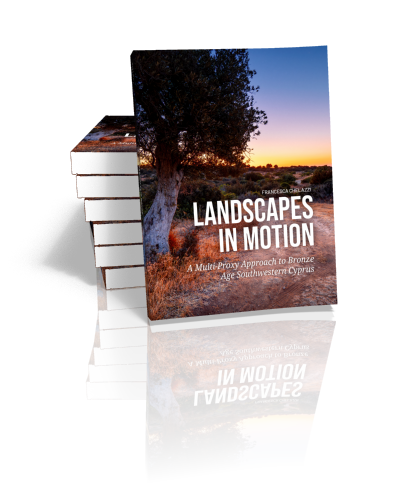
Landscapes in Motion
A Multi-Proxy Approach to Bronze Age Southwestern Cyprus
Francesca Chelazzi | Forthcoming
Paperback ISBN: 9789464271928 | Hardback ISBN: 9789464271935 | Imprint: Sidestone Press Academics | Format: 210x280mm | ca. 280 pp. | Language: English | 4 illus. (bw) | 103 illus. (fc) | Keywords: Bronze Age Cyprus; multi-proxy analysis; spatial statistics; GIS and computational modelling; settlement patterns; complexity theory; legacy data integration; human-environment interaction | download cover | DOI: 10.59641/j3y8k9b2v6 | CC-license: CC BY-NC-ND 4.0
Publication date: 20-05-2027
-
Digital & Online access
Digital/Online version not (yet) available
-
Buy via Sidestone (EU & UK)
Get €5.00 discount on forthcoming books by using coupon code "PRE-ORDER" in your shopping cart!
-
Buy via our Distributors (WORLD)
For non-EU or UK destinations you can buy our books via our international distributors. Although prices may vary this will ensure speedy delivery and reduction in shipping costs or import tax. But you can also order with us directly via the module above.
For UK & other International destinations
For USA/Canada & other International destinations
-
Bookinfo
Paperback ISBN: 9789464271928 | Hardback ISBN: 9789464271935 | Imprint: Sidestone Press Academics | Format: 210x280mm | ca. 280 pp. | Language: English | 4 illus. (bw) | 103 illus. (fc) | Keywords: Bronze Age Cyprus; multi-proxy analysis; spatial statistics; GIS and computational modelling; settlement patterns; complexity theory; legacy data integration; human-environment interaction | download cover | DOI: 10.59641/j3y8k9b2v6 | CC-license: CC BY-NC-ND 4.0
Publication date: 20-05-2027

We will plant a tree for each order containing a paperback or hardback book via OneTreePlanted.org.
For over a century, the Bronze Age of Cyprus has been famous primarily for one thing: copper. The island’s wealth in metal earned it the reputation as a ‘crossroads of civilisations’, and generations of scholars have mapped its trade networks across the Mediterranean. But this emphasis on copper and commerce has cast a larger question into the shadows: how did the communities who really lived on Cyprus shape and transform the landscapes they inhabited?
This book looks at Cyprus from within. Focusing on the southwest of the island for some fourteen centuries (c. 2400–1000 BCE), it shifts attention away from external trade and towards the daily choices of local communities: where they lived, how they used their land, when they opted to engage with others and when to keep their distance.
To retrieve these stories, the book assembles seven decades of archaeological fieldwork, from the 1950s to today, and reads them anew through spatial statistics, GIS and computational modelling. This multi-proxy approach reveals patterns that traditional methods could not: how small changes could cascade into major social transformations, and how communities built resilience not through rigid hierarchy but through flexibility and experiment.
The result is a fresh account of how island communities negotiated their local autonomy with wider connections, and a model for how fragmentary archaeological data can be brought back to life. It will appeal to archaeologists of the Mediterranean, specialists in digital and quantitative methods, and all those interested in how past societies coped with a changing world.
List of Figures
List of Tables
Acknowledgements
1. Introduction
2. Pathways in regionalism: space, time and tempo
2.1 The space of regionalism
2.2 The time and tempo of regionalism
2.3 The making of Cypriot regionalism
3. Landscapes in focus: data, scales and perspectives
3.1 Zooming in and out: scales of analysis
3.2 Beyond quantity: rethinking archaeological data
4. The landscape of southwestern Cyprus
4.1 The natural landscape
4.2 The interpolated and modelled landscapes
5. The archaeological legacy of southwestern Cyprus
5.1 Surveys, excavations, and legacy data
5.2 Previous experiments with data aggregation in Cyprus
5.3 Data certainty and accuracy
5.4 Ground-truthing and data cleaning
6. Settlement pattern: communities in motion and landscape change
6.1 At the dawn of the Bronze Age: the ‘marginal’ south in the Philia
6.2 The Bronze Age period in the southwest
6.3 Comparing data across the southwest
6.4 The rest of the island during the Bronze Age
7. Economic landscapes: analysing the intersection of resources and space
7.1 Reconstructing agrarian lifeways through bioarchaeological data
7.2 Spatial analysis of agricultural potential: computational modelling of Land Capability
7.3 Extractive economies: the mining industry of the southwest
7.4 Beyond agriculture and mining: diversified resource exploitation
8. Regional integration and territorial organisation
8.1 Moving people, goods and ideas across southwestern Cyprus
8.2 Supra-regional connections and trade networks
8.3 Territoriality and strategic landscape control
9. Pathways of complexity 1: multi-scalar adaptability and tipping points in Early and Middle Bronze Age social transformation
9.1 Unpacking ‘social complexity’: dynamic instability and adaptive systems in pre-Bronze Age Cyprus
9.2 Households at the edge of chaos: distributed systems and multi-scalar adaptability in PreBA household economies
9.3 The reciprocity-specialisation nexus: network restructuring and emergent transaction norms in PreBA 2 and ProBA 1
9.4 Critical transitions and tipping points: spatial reconfiguration in ProBA 1
10. Pathways of complexity 2: network crystallisation and institutional divergence in Late Bronze Age political systems
10.1 Competitive coevolution and status differentiation: multi-scalar dynamics in emerging political hierarchies in ProBA 2
10.2 Organisational bifurcation and alternative trajectories: competing models of political complexity in ProBA 3
10.3 Crisis response and institutional resilience: network fragmentation and adaptive capacity in the very Early Iron Age
11. Landscapes still in motion: synthesis and prospects
11.1 Landscape co-construction: communities shaping their worlds
11.2 Adaptive cycles and system transformations
11.3 Networks in motion: from local worlds to Mediterranean webs
11.4 Institutional plasticity: how different systems emerged from similar conditions
11.5 Knowledge networks and emergent standardisation
11.6 Five threads, one tapestry: rethinking Bronze Age social landscapes
APPENDIX A. List of the archaeological sites
APPENDIX B. Supplementary material for Chapter 6
APPENDIX C. Supplementary material for Chapter 7
APPENDIX D. Supplementary material for Chapter 8
Bibliography
Dr. Francesca Chelazzi
Francesca Chelazzi is a landscape archaeologist specialising in Southwest Asia, with particular expertise in the study of ancient landscapes and societies using computational methods (GIS, spatial statistics, computational modelling and remote sensing). Her research interests include long-term human–environment interaction, urbanisation and inequality across the ancient Near East and the Eastern Mediterranean. She has carried out over a decade of fieldwork in Cyprus, leading and participating in both excavation and survey projects. She is currently a Gerda Henkel Research Fellow, a Research Affiliate at the University of Glasgow and a Visiting Scholar at the University of Pisa. She also serves as Associate Director of the Sirwan Regional Project (Iraqi Kurdistan). In the past, she held research positions at the University of Cyprus and Durham University.

Chelazzi, F. (in press). Landscapes in Motion. A Multi-Proxy Approach to Bronze Age Southwestern Cyprus. Sidestone Press. https://doi.org/10.59641/j3y8k9b2v6
Abstract:
For over a century, the Bronze Age of Cyprus has been famous primarily for one thing: copper. The island’s wealth in metal earned it the reputation as a ‘crossroads of civilisations’, and generations of scholars have mapped its trade networks across the Mediterranean. But this emphasis on copper and commerce has cast a larger question into the shadows: how did the communities who really lived on Cyprus shape and transform the landscapes they inhabited?
This book looks at Cyprus from within. Focusing on the southwest of the island for some fourteen centuries (c. 2400–1000 BCE), it shifts attention away from external trade and towards the daily choices of local communities: where they lived, how they used their land, when they opted to engage with others and when to keep their distance.
To retrieve these stories, the book assembles seven decades of archaeological fieldwork, from the 1950s to today, and reads them anew through spatial statistics, GIS and computational modelling. This multi-proxy approach reveals patterns that traditional methods could not: how small changes could cascade into major social transformations, and how communities built resilience not through rigid hierarchy but through flexibility and experiment.
The result is a fresh account of how island communities negotiated their local autonomy with wider connections, and a model for how fragmentary archaeological data can be brought back to life. It will appeal to archaeologists of the Mediterranean, specialists in digital and quantitative methods, and all those interested in how past societies coped with a changing world.
Contents
List of Figures
List of Tables
Acknowledgements
1. Introduction
2. Pathways in regionalism: space, time and tempo
2.1 The space of regionalism
2.2 The time and tempo of regionalism
2.3 The making of Cypriot regionalism
3. Landscapes in focus: data, scales and perspectives
3.1 Zooming in and out: scales of analysis
3.2 Beyond quantity: rethinking archaeological data
4. The landscape of southwestern Cyprus
4.1 The natural landscape
4.2 The interpolated and modelled landscapes
5. The archaeological legacy of southwestern Cyprus
5.1 Surveys, excavations, and legacy data
5.2 Previous experiments with data aggregation in Cyprus
5.3 Data certainty and accuracy
5.4 Ground-truthing and data cleaning
6. Settlement pattern: communities in motion and landscape change
6.1 At the dawn of the Bronze Age: the ‘marginal’ south in the Philia
6.2 The Bronze Age period in the southwest
6.3 Comparing data across the southwest
6.4 The rest of the island during the Bronze Age
7. Economic landscapes: analysing the intersection of resources and space
7.1 Reconstructing agrarian lifeways through bioarchaeological data
7.2 Spatial analysis of agricultural potential: computational modelling of Land Capability
7.3 Extractive economies: the mining industry of the southwest
7.4 Beyond agriculture and mining: diversified resource exploitation
8. Regional integration and territorial organisation
8.1 Moving people, goods and ideas across southwestern Cyprus
8.2 Supra-regional connections and trade networks
8.3 Territoriality and strategic landscape control
9. Pathways of complexity 1: multi-scalar adaptability and tipping points in Early and Middle Bronze Age social transformation
9.1 Unpacking ‘social complexity’: dynamic instability and adaptive systems in pre-Bronze Age Cyprus
9.2 Households at the edge of chaos: distributed systems and multi-scalar adaptability in PreBA household economies
9.3 The reciprocity-specialisation nexus: network restructuring and emergent transaction norms in PreBA 2 and ProBA 1
9.4 Critical transitions and tipping points: spatial reconfiguration in ProBA 1
10. Pathways of complexity 2: network crystallisation and institutional divergence in Late Bronze Age political systems
10.1 Competitive coevolution and status differentiation: multi-scalar dynamics in emerging political hierarchies in ProBA 2
10.2 Organisational bifurcation and alternative trajectories: competing models of political complexity in ProBA 3
10.3 Crisis response and institutional resilience: network fragmentation and adaptive capacity in the very Early Iron Age
11. Landscapes still in motion: synthesis and prospects
11.1 Landscape co-construction: communities shaping their worlds
11.2 Adaptive cycles and system transformations
11.3 Networks in motion: from local worlds to Mediterranean webs
11.4 Institutional plasticity: how different systems emerged from similar conditions
11.5 Knowledge networks and emergent standardisation
11.6 Five threads, one tapestry: rethinking Bronze Age social landscapes
APPENDIX A. List of the archaeological sites
APPENDIX B. Supplementary material for Chapter 6
APPENDIX C. Supplementary material for Chapter 7
APPENDIX D. Supplementary material for Chapter 8
Bibliography
Dr. Francesca Chelazzi
Francesca Chelazzi is a landscape archaeologist specialising in Southwest Asia, with particular expertise in the study of ancient landscapes and societies using computational methods (GIS, spatial statistics, computational modelling and remote sensing). Her research interests include long-term human–environment interaction, urbanisation and inequality across the ancient Near East and the Eastern Mediterranean. She has carried out over a decade of fieldwork in Cyprus, leading and participating in both excavation and survey projects. She is currently a Gerda Henkel Research Fellow, a Research Affiliate at the University of Glasgow and a Visiting Scholar at the University of Pisa. She also serves as Associate Director of the Sirwan Regional Project (Iraqi Kurdistan). In the past, she held research positions at the University of Cyprus and Durham University.
-
Digital & Online access
Digital/Online version not (yet) available
-
Buy via Sidestone (EU & UK)
Get €5.00 discount on forthcoming books by using coupon code "PRE-ORDER" in your shopping cart!
-
Buy via our Distributors (WORLD)
For non-EU or UK destinations you can buy our books via our international distributors. Although prices may vary this will ensure speedy delivery and reduction in shipping costs or import tax. But you can also order with us directly via the module above.
For UK & other International destinations
For USA/Canada & other International destinations
- Browse all books by subject
-
Search all books
We will plant a tree for each order containing a paperback or hardback book via OneTreePlanted.org.
You might also like:





© 2026 Sidestone Press KvK nr. 28114891 Privacy policy Sidestone Newsletter Terms and Conditions (Dutch)