


Death in Times of Change
Transformations of Prehistoric Hunter-Fisher Burial Rituals Between the Baltic and the Urals
Anastasia Khramtsova | Forthcoming
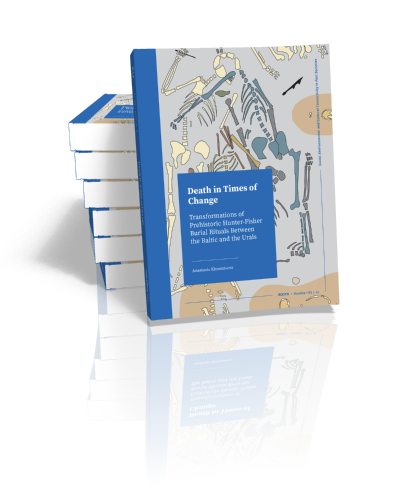
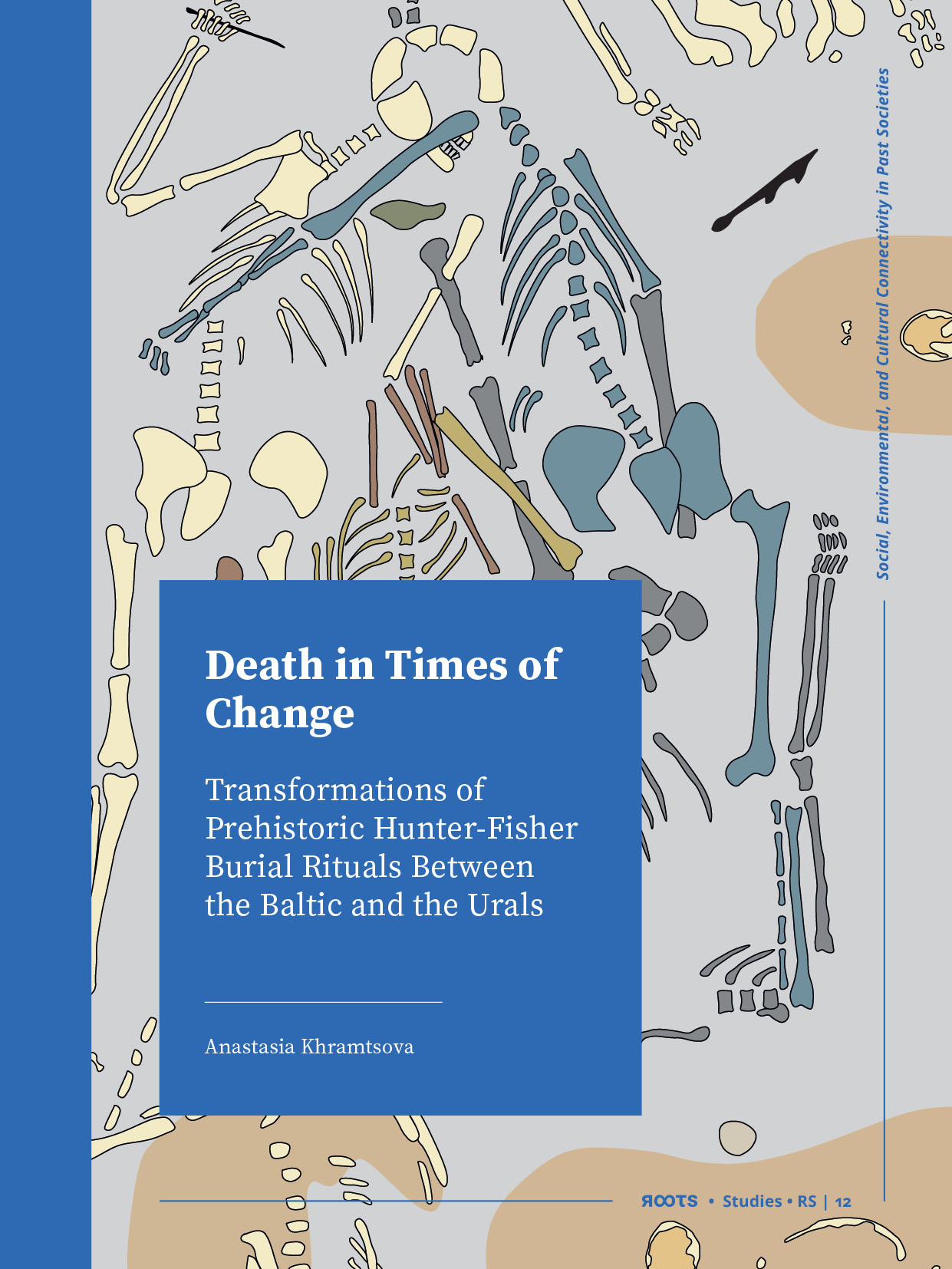
Death in Times of Change
Transformations of Prehistoric Hunter-Fisher Burial Rituals Between the Baltic and the Urals
Anastasia Khramtsova | Forthcoming
Paperback ISBN: 9789464281323 | Hardback ISBN: 9789464281330 | Imprint: Sidestone Press Dissertations | Format: 210x280mm | ca. 386 pp. | ROOTS Studies 12 | Series: ROOTS Studies | Language: English | 45 illus. (bw) | 151 illus. (fc) | Keywords: hunter-gatherer societies; archaeology of Eurasia; burial practices; East European Plain; early-mid Holocene; Stone Age; Mesolithic; Neolithic; Early Metal Age; socio-cultural transformations | download cover | DOI: 10.59641/bbb278en | CC-license: CC BY 4.0
Publication date: 29-10-2026
-
Digital & Online access
Digital/Online version not (yet) available
-
Buy via Sidestone (EU & UK)
Get €5.00 discount on forthcoming books by using coupon code "PRE-ORDER" in your shopping cart!
-
Buy via our Distributors (WORLD)
For non-EU or UK destinations you can buy our books via our international distributors. Although prices may vary this will ensure speedy delivery and reduction in shipping costs or import tax. But you can also order with us directly via the module above.
For UK & other International destinations
For USA/Canada & other International destinations
-
Bookinfo
Paperback ISBN: 9789464281323 | Hardback ISBN: 9789464281330 | Imprint: Sidestone Press Dissertations | Format: 210x280mm | ca. 386 pp. | ROOTS Studies 12 | Series: ROOTS Studies | Language: English | 45 illus. (bw) | 151 illus. (fc) | Keywords: hunter-gatherer societies; archaeology of Eurasia; burial practices; East European Plain; early-mid Holocene; Stone Age; Mesolithic; Neolithic; Early Metal Age; socio-cultural transformations | download cover | DOI: 10.59641/bbb278en | CC-license: CC BY 4.0
Publication date: 29-10-2026

We will plant a tree for each order containing a paperback or hardback book via OneTreePlanted.org.
This book examines burial rituals among prehistoric communities that inhabited the East European forest zone between ca. 9500 and 2700 cal BCE. Based on evidence from 130 burial sites with a total of 1406 graves located between the Baltic and the Urals, the study provides a detailed examination of burial practices from the Mesolithic to the Early Bronze Age.
Drawing upon extensive archaeological data and employing a multivariate statistical method, the research addresses key questions regarding the evolution of hunter-fisher-gatherer burial customs and the factors driving these changes.
The study identifies three major transformations in burial practices among foraging populations. Each transformation appears to be associated with socio-structural, cultural and environmental changes, resulting in significant shifts in burial behaviour, as reflected in burial site location, body positioning, post-mortem manipulations, grave goods, and accompanying burial features.
The research points to the evolving differential treatment of deceased children and women over time, indicating shifts in societal, age-related as well as gender-related attitudes. Previously undocumented burial practices, such as post-depositional grave disturbances and partial and full cremation, contribute to our understanding of mortuary traditions among local forest-zone foragers.
Overall, the book sheds light on the social, cultural, and environmental dynamics of prehistoric communities in Eurasia, based on a comprehensive analysis of burial practices and their implications for broader societal changes.
Foreword of the series editors
Acknowledgements
Chapter 1: Introduction
1.1. Setting the scene
1.2. Scope of the study – Aims and objectives
1.2.1. Research hypotheses
1.2.2. Methodology
1.3. Thesis structure
Chapter 2: Hunter-fisher burial sites in Soviet and Russian research – Literature review
2.1. The perception of Early-Middle-Holocene burial rituals in Soviet-Russian archaeology
2.1.1. In search of the ancestors of the Slavs – First discoveries of Late Stone Age burials (from the 1880s to 1920)
2.1.2. Just indifferent cannibals? Research activity in Soviet Russia on the brink of regime tightening (1920s)
2.1.3. Religious beliefs as a mirror of social structure (1929 and the 1930s)
2.1.4. Facing the dead and planting their roots – Historical reconstruction and Indigenism in the time of the Great Construction Project of Communism (1946-1950)
2.1.5. Ethnicity, language, and material culture – Combined analyses of social structure at large cemeteries (the 1950s and the 1960s)
2.1.6. Empiricism, definitionism, structuralism – On the way to theoretical diversity within Marxist philosophy and non-conformist papers (the 1970s and the 1980s)
2.1.7. Attention focusing on cemetery features, revival of semiotics, and a new archaeology of death (1990-present)
2.1.8. Conclusions
2.2. Gaps in the literature
2.2.1. Source-related gaps
2.2.2. Methodological/conceptual gaps
2.2.3. Epistemological gaps
2.2.4. Towards filling the gaps
Chapter 3: The world of prehistoric foragers and its transformations
3.1. Hunter-fisher archaeology between the Baltic and the Urals – General overview
3.1.1. Terminological legacy
3.1.2. Marxist legacies and the emerging directions in the archaeology of hunter-fishers
3.1.3. Prehistoric foragers of the East European Plain and their ways of life – State of the art
3.2. The feel of the steppe – Transformations in the southeastern part of the East European Plain
3.2.1. Geographical characteristics
3.2.2. Socio-cultural processes in the area – Main findings, theories, chronology
3.2.3. Conclusions
3.3. The open space – Hunter-fishers in the central part of the East European Plain
3.3.1. Geographical characteristics
3.3.2. Socio-cultural processes in the area – Main findings, theories, chronology
3.3.3. Conclusions
3.4. The traditions they brought – Settling down in the northwestern part of the East European Plain
3.4.1. Geographical characteristics
3.4.2. Socio-cultural processes in the area – Peculiarity of lithic preferences, surge of ceramic traditions, and rise of social complexity
3.4.3. Conclusions
3.5. Place of death in the course of socio-cultural transformations – Conclusion
Chapter 4: Theoretical framework
4.1. Situating this study within contemporary debates
4.1.1. At the crossroads of the archaeology of burials
4.2. On the nature of ritual
4.3. Overview of three major theories
4.3.1. Rituals in action – Behavioural archaeology
4.3.2. Contextualism
4.3.3. Structuralism
4.3.4. The relationship among the concepts
4.4. From burial rituals to mortuary practices – System of definitions
Chapter 5: Data and methods
5.1. Problem-oriented research
5.2. Data collection
5.2.1. Data sources
5.2.2. Tools used to collect data
5.2.3. Database structure
5.3. Analytical tools
5.3.1. Big Data – Multiple factor analysis vs. principal component analysis
5.3.2. Contextual analysis
5.3.3. Natural scientific analyses
5.4. Who owns the bones? Ethical considerations
5.5. Conclusion
Chapter 6: Between Europe and Asia – The southeastern part of the East European Plain
6.1. Early-Middle Holocene burial practices in the area – State of the art
6.1.1. History of research
6.1.2. Chronological framework
6.1.3. Existing understanding of the hunter-fisher burial rituals in the area
6.2. General characteristics of the archaeological material
6.3. Results
6.3.1. Burial goods
6.3.2. Anthropological remains
6.3.3. Accompanying burial features – Analysis
6.3.4. Chronological sequence of the graves
6.4. Change in mortuary rituals in the context of other transformations – Conclusions
Chapter 7: The central part of the East European Plain
7.1. Studies of the hunter-fisher interments in the area – State of the art
7.1.1. Methods and research scale
7.1.2. Chronological framework
7.1.3. Existing interpretation of hunter-fisher-gatherer burial rituals in the area
7.2. General characteristics of archaeological material
7.3. Results
7.3.1. Burial goods
7.3.2. Anthropological remains
7.3.3. Accompanying burial features
7.4. Diversity and dynamics of changes in mortuary rituals in the context of other transformations – Conclusions
Chapter 8: Selected observations on the hunter-fisher rituals in the northwestern part of the East European Plain
8.1. Hunter-gatherer burial studies in the area – State of the art
8.1.1. Methods and research scale
8.1.2. Chronological framework
8.1.3. Observations on the burial rituals of the local prehistoric foragers
8.2. General characteristics of archaeological material
8.3. The results of investigations
8.3.1. Burial goods
8.3.2. Anthropological remains
8.3.3. Accompanying burial features
8.4. Conclusions – Implication of the findings
Chapter 9: Of grave importance – Transformation of hunter-fisher burial rituals in a larger context
9.1. Relationships between the observations – Trends, generalisations, underlying patterns and mechanisms
9.1.1. Global transformations
9.2. Thematic insights from burial data
9.2.1. Death in a violent world? Life after violent death?
9.2.2. Some thoughts on the societal differentiation based on the burial material
9.2.3. Dead people revisited – Post-depositional grave disturbances
9.2.4. When they overcame the flames – Role of cremation in the burial rituals of the prehistoric forest foragers
Chapter 10: Changing rituals, changing worlds – Conclusion
10.1. Preservation, chronology, generalisation and other limitations of the study
10.2. Ways forward – Perspectives for further research work
10.2.1. Scenery for death and burials – The role of the landscape for interments, the re-use of burial spaces, and the relation of settlements to cemeteries
10.2.2. Burial kits – The long story
10.2.3. Wrapped, disarticulated, dismembered, fragmented, burnt, and buried – A look into particular burial practices
Summaries
Summary in German (Zusammenfassung)
Summary in Russian (Резюме)
References
Archival sources
Appendices
Appendix A: Catalogue of hunter-fisher burial sites in the East European forest zone
Southeastern part of the East European Plain
Central part of the East European Plain
Northwestern part of the East European Plain
Appendix B: Radiocarbon chronology
Table of radiocarbon dates
Online supplements
Supplement 1 – Hunter-fisher burial sites of the East European Plain forest – Dataset
Supplement 2 – Description of sources
Supplement 3 – Data reliability and chronological framework
Supplement 4 – Additional figures
Dr. Anastasia Khramtsova
Anastasia Khramtsova, a managing editor of the Ethnographisch-Archaeologische Zeitschrift, Kiel University, conducted her Ph.D. programme in Pre- and Protohistory at Kiel University after complementing her earlier degrees in history archaeology from St. Petersburg State University and Moscow State University. Her research focuses on Early-Middle Holocene hunter-fisher-gatherer societies, with a particular emphasis on burial rituals and lithic technology.

Khramtsova, A. (in press). Death in Times of Change. Transformations of Prehistoric Hunter-Fisher Burial Rituals Between the Baltic and the Urals. ROOTS Studies 12. Sidestone Press. https://doi.org/10.59641/bbb278en
Abstract:
This book examines burial rituals among prehistoric communities that inhabited the East European forest zone between ca. 9500 and 2700 cal BCE. Based on evidence from 130 burial sites with a total of 1406 graves located between the Baltic and the Urals, the study provides a detailed examination of burial practices from the Mesolithic to the Early Bronze Age.
Drawing upon extensive archaeological data and employing a multivariate statistical method, the research addresses key questions regarding the evolution of hunter-fisher-gatherer burial customs and the factors driving these changes.
The study identifies three major transformations in burial practices among foraging populations. Each transformation appears to be associated with socio-structural, cultural and environmental changes, resulting in significant shifts in burial behaviour, as reflected in burial site location, body positioning, post-mortem manipulations, grave goods, and accompanying burial features.
The research points to the evolving differential treatment of deceased children and women over time, indicating shifts in societal, age-related as well as gender-related attitudes. Previously undocumented burial practices, such as post-depositional grave disturbances and partial and full cremation, contribute to our understanding of mortuary traditions among local forest-zone foragers.
Overall, the book sheds light on the social, cultural, and environmental dynamics of prehistoric communities in Eurasia, based on a comprehensive analysis of burial practices and their implications for broader societal changes.
Contents
Foreword of the series editors
Acknowledgements
Chapter 1: Introduction
1.1. Setting the scene
1.2. Scope of the study – Aims and objectives
1.2.1. Research hypotheses
1.2.2. Methodology
1.3. Thesis structure
Chapter 2: Hunter-fisher burial sites in Soviet and Russian research – Literature review
2.1. The perception of Early-Middle-Holocene burial rituals in Soviet-Russian archaeology
2.1.1. In search of the ancestors of the Slavs – First discoveries of Late Stone Age burials (from the 1880s to 1920)
2.1.2. Just indifferent cannibals? Research activity in Soviet Russia on the brink of regime tightening (1920s)
2.1.3. Religious beliefs as a mirror of social structure (1929 and the 1930s)
2.1.4. Facing the dead and planting their roots – Historical reconstruction and Indigenism in the time of the Great Construction Project of Communism (1946-1950)
2.1.5. Ethnicity, language, and material culture – Combined analyses of social structure at large cemeteries (the 1950s and the 1960s)
2.1.6. Empiricism, definitionism, structuralism – On the way to theoretical diversity within Marxist philosophy and non-conformist papers (the 1970s and the 1980s)
2.1.7. Attention focusing on cemetery features, revival of semiotics, and a new archaeology of death (1990-present)
2.1.8. Conclusions
2.2. Gaps in the literature
2.2.1. Source-related gaps
2.2.2. Methodological/conceptual gaps
2.2.3. Epistemological gaps
2.2.4. Towards filling the gaps
Chapter 3: The world of prehistoric foragers and its transformations
3.1. Hunter-fisher archaeology between the Baltic and the Urals – General overview
3.1.1. Terminological legacy
3.1.2. Marxist legacies and the emerging directions in the archaeology of hunter-fishers
3.1.3. Prehistoric foragers of the East European Plain and their ways of life – State of the art
3.2. The feel of the steppe – Transformations in the southeastern part of the East European Plain
3.2.1. Geographical characteristics
3.2.2. Socio-cultural processes in the area – Main findings, theories, chronology
3.2.3. Conclusions
3.3. The open space – Hunter-fishers in the central part of the East European Plain
3.3.1. Geographical characteristics
3.3.2. Socio-cultural processes in the area – Main findings, theories, chronology
3.3.3. Conclusions
3.4. The traditions they brought – Settling down in the northwestern part of the East European Plain
3.4.1. Geographical characteristics
3.4.2. Socio-cultural processes in the area – Peculiarity of lithic preferences, surge of ceramic traditions, and rise of social complexity
3.4.3. Conclusions
3.5. Place of death in the course of socio-cultural transformations – Conclusion
Chapter 4: Theoretical framework
4.1. Situating this study within contemporary debates
4.1.1. At the crossroads of the archaeology of burials
4.2. On the nature of ritual
4.3. Overview of three major theories
4.3.1. Rituals in action – Behavioural archaeology
4.3.2. Contextualism
4.3.3. Structuralism
4.3.4. The relationship among the concepts
4.4. From burial rituals to mortuary practices – System of definitions
Chapter 5: Data and methods
5.1. Problem-oriented research
5.2. Data collection
5.2.1. Data sources
5.2.2. Tools used to collect data
5.2.3. Database structure
5.3. Analytical tools
5.3.1. Big Data – Multiple factor analysis vs. principal component analysis
5.3.2. Contextual analysis
5.3.3. Natural scientific analyses
5.4. Who owns the bones? Ethical considerations
5.5. Conclusion
Chapter 6: Between Europe and Asia – The southeastern part of the East European Plain
6.1. Early-Middle Holocene burial practices in the area – State of the art
6.1.1. History of research
6.1.2. Chronological framework
6.1.3. Existing understanding of the hunter-fisher burial rituals in the area
6.2. General characteristics of the archaeological material
6.3. Results
6.3.1. Burial goods
6.3.2. Anthropological remains
6.3.3. Accompanying burial features – Analysis
6.3.4. Chronological sequence of the graves
6.4. Change in mortuary rituals in the context of other transformations – Conclusions
Chapter 7: The central part of the East European Plain
7.1. Studies of the hunter-fisher interments in the area – State of the art
7.1.1. Methods and research scale
7.1.2. Chronological framework
7.1.3. Existing interpretation of hunter-fisher-gatherer burial rituals in the area
7.2. General characteristics of archaeological material
7.3. Results
7.3.1. Burial goods
7.3.2. Anthropological remains
7.3.3. Accompanying burial features
7.4. Diversity and dynamics of changes in mortuary rituals in the context of other transformations – Conclusions
Chapter 8: Selected observations on the hunter-fisher rituals in the northwestern part of the East European Plain
8.1. Hunter-gatherer burial studies in the area – State of the art
8.1.1. Methods and research scale
8.1.2. Chronological framework
8.1.3. Observations on the burial rituals of the local prehistoric foragers
8.2. General characteristics of archaeological material
8.3. The results of investigations
8.3.1. Burial goods
8.3.2. Anthropological remains
8.3.3. Accompanying burial features
8.4. Conclusions – Implication of the findings
Chapter 9: Of grave importance – Transformation of hunter-fisher burial rituals in a larger context
9.1. Relationships between the observations – Trends, generalisations, underlying patterns and mechanisms
9.1.1. Global transformations
9.2. Thematic insights from burial data
9.2.1. Death in a violent world? Life after violent death?
9.2.2. Some thoughts on the societal differentiation based on the burial material
9.2.3. Dead people revisited – Post-depositional grave disturbances
9.2.4. When they overcame the flames – Role of cremation in the burial rituals of the prehistoric forest foragers
Chapter 10: Changing rituals, changing worlds – Conclusion
10.1. Preservation, chronology, generalisation and other limitations of the study
10.2. Ways forward – Perspectives for further research work
10.2.1. Scenery for death and burials – The role of the landscape for interments, the re-use of burial spaces, and the relation of settlements to cemeteries
10.2.2. Burial kits – The long story
10.2.3. Wrapped, disarticulated, dismembered, fragmented, burnt, and buried – A look into particular burial practices
Summaries
Summary in German (Zusammenfassung)
Summary in Russian (Резюме)
References
Archival sources
Appendices
Appendix A: Catalogue of hunter-fisher burial sites in the East European forest zone
Southeastern part of the East European Plain
Central part of the East European Plain
Northwestern part of the East European Plain
Appendix B: Radiocarbon chronology
Table of radiocarbon dates
Online supplements
Supplement 1 – Hunter-fisher burial sites of the East European Plain forest – Dataset
Supplement 2 – Description of sources
Supplement 3 – Data reliability and chronological framework
Supplement 4 – Additional figures
Dr. Anastasia Khramtsova
Anastasia Khramtsova, a managing editor of the Ethnographisch-Archaeologische Zeitschrift, Kiel University, conducted her Ph.D. programme in Pre- and Protohistory at Kiel University after complementing her earlier degrees in history archaeology from St. Petersburg State University and Moscow State University. Her research focuses on Early-Middle Holocene hunter-fisher-gatherer societies, with a particular emphasis on burial rituals and lithic technology.
-
Digital & Online access
Digital/Online version not (yet) available
-
Buy via Sidestone (EU & UK)
Get €5.00 discount on forthcoming books by using coupon code "PRE-ORDER" in your shopping cart!
-
Buy via our Distributors (WORLD)
For non-EU or UK destinations you can buy our books via our international distributors. Although prices may vary this will ensure speedy delivery and reduction in shipping costs or import tax. But you can also order with us directly via the module above.
For UK & other International destinations
For USA/Canada & other International destinations
- Browse all books by subject
-
Search all books
We will plant a tree for each order containing a paperback or hardback book via OneTreePlanted.org.
You might also like:



© 2026 Sidestone Press KvK nr. 28114891 Privacy policy Sidestone Newsletter Terms and Conditions (Dutch)