


Between Thy and Tübingen
Late Palaeolithic and Mesolithic hunter-gatherer worlds in transition. Studies in honour of Berit V. Eriksen
Edited by Sascha Krüger and Daniel Groß | 2026
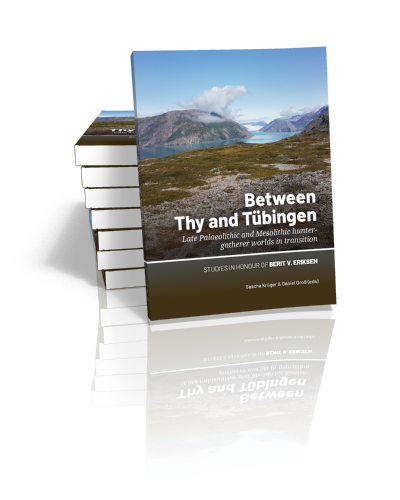
Between Thy and Tübingen
Late Palaeolithic and Mesolithic hunter-gatherer worlds in transition. Studies in honour of Berit V. Eriksen
Edited by Sascha Krüger and Daniel Groß | 2026
Paperback ISBN: 9789464271560 | Hardback ISBN: 9789464271577 | Imprint: Sidestone Press Academics | Format: 210x280mm | 256 pp. | Language: English | 22 illus. (bw) | 69 illus. (fc) | Keywords: archaeology; central Europe; Scandinavia; lithic technology; stable isotopes; palynology; geophysics; burial practices; resource exploitation; decorations; antler technology | download cover | DOI: 10.59641/l6o2i3j4k5 | CC-license: CC BY 4.0
Read online or downloaded 588 times
-
Digital & Online access
This is a full Open Access publication, click below to buy in print, browse, or download for free.
-
Buy via Sidestone (EU & UK)
-
Buy via our Distributors (WORLD)
For non-EU or UK destinations you can buy our books via our international distributors. Although prices may vary this will ensure speedy delivery and reduction in shipping costs or import tax. But you can also order with us directly via the module above.
UK international distributor
USA international distributor
-
Bookinfo
Paperback ISBN: 9789464271560 | Hardback ISBN: 9789464271577 | Imprint: Sidestone Press Academics | Format: 210x280mm | 256 pp. | Language: English | 22 illus. (bw) | 69 illus. (fc) | Keywords: archaeology; central Europe; Scandinavia; lithic technology; stable isotopes; palynology; geophysics; burial practices; resource exploitation; decorations; antler technology | download cover | DOI: 10.59641/l6o2i3j4k5 | CC-license: CC BY 4.0
Read online or downloaded 588 times

We will plant a tree for each order containing a paperback or hardback book via OneTreePlanted.org.
This volume brings together twenty peer-reviewed studies honouring the scholarly career of Berit V. Eriksen, whose research has been highly influential in the study of Late Palaeolithic and Mesolithic hunter-gatherers in central Europe and southern Scandinavia. The contributions focus on the Late Glacial and Early Holocene, a time marked by profound environmental, social, and technological transformations that reshaped hunter-gatherer lifeways.
Reflecting both Eriksen’s research interests and current debates in the field, the contributions address a broad range of themes in hunter-gatherer research. These include lithic technology and raw material procurement, long-distance connections and exotic materials, subsistence strategies, burial practices, and aesthetic expression. Several contributions emphasise methodological and theoretical innovation, employing approaches such as geophysical survey, palynology, isotopic analyses, and taphonomic studies to refine chronologies, reconstruct past environments and human-environmental interactions.
Geographically, the volume spans across northern Germany, Denmark, southern Scandinavia, the Baltic region, and adjacent areas, offering case studies that illuminate both regional variability and wider patterns of transition. Particular attention is given to processes of change and continuity, including the emergence of Mesolithic lifeways, shifting relationships between humans, animals, and environments, and the complex responses of hunter-gatherer societies to climatic and ecological challenges. Together, the contributions question linear narratives of cultural development and highlight the diversity and dynamism of Late Palaeolithic and Mesolithic worlds.
Aimed at researchers, students, and readers with an interest in early prehistory, this volume presents new data, innovative interpretations, and critical reflections that advance our understanding of hunter-gatherer societies at the end of the Ice Age and the beginning of the Holocene, while celebrating Berit V. Eriksen’s lasting impact on the discipline.
Sisterhood in archaeology: Berit Valentin Eriksen as mentor
Sonja B. Grimm, Helene Agerskov Rose, Katrine Balsgaard Juul, Charlotte Damm and Inger Marie Berg-Hansen
Technical Practices and Social Dynamics: A Comparative Study of Havelte Group and Federmesser-Gruppen in Late Glacial Northern Europe
Tobias Reuter
Questioning the linear evolution of the Federmesser-Gruppen /Late Azilian lithic assemblages. Insights from Northern Germany and the Paris Basin
Tobias Reuter, Sofiane Bouziane, Mara-Julia Weber and Ludovic Mevel
Taphonomy, stratigraphy, chronology, and settlement choice at the Blätterhöhle – new results and open questions
Florian Gumboldt, Tom Noack, Michael Baales, Jörg Orschiedt, Wolfgang Heuschen and Andreas Maier
Swiderian sites on the shores of Kalviai Lake, southern Lithuania
Tomas Rimkus
From Ice Age to Insight: The study of the Ahrensburg Tunnel Valley through time
Moiken Hinrichs and Katja Winkler
Not just red. Identification of red Heligoland Flint by macroscopic and microscopic characteristics
Hauke Jürgens, Sönke Hartz and Joachim Schönfeld
The colour of magic: exotic raw materials, prospecting, and the Late Palaeolithic of northern Europe
Felix Riede
‘Lyngby axes’ from Ahrensburg (Schleswig-Holstein, Germany) – Supplementary material
Éva David
Active and passive seismic measurements for mapping and investigating kettle holes: an example from Tyrsted (Jutland, Denmark)
Erica Corradini, Stine Detjens, Manuel Zolchow, Martin Thorwart, Nina Kallinich and Wolfgang Rabbel
Green shadows beneath the waves – a speculative vegetation survey of Doggerland during the GS-1
Sascha Krüger and Benjamin R. Gearey
Isotopic niche partitioning between reindeer and horse in Northwest Europe during the Final Upper Palaeolithic
Dorothée G. Drucker
Looking for diachronic patterns in Danish Mesolithic diets
John Meadows and Anders Fischer
Becoming Mesolithic. Reflections on the mesolithisation in southern Scandinavia and northern Germany
Mikkel Sørensen
Sticks, Stones and Bones. Recent Early Mesolithic finds from Lolland, Denmark
Daniel Groß, Peter Deichmann, Sandra Söderlind, Ulrich Schmölcke and Bente Philippsen
The Northwest-German Mesolithic gap and how to fill it – A survey for water-logged Mesolithic sites
Svea Mahlstedt, Annette Siegmüller, Martina Karle and Steffen Wolters
Hunter-Gatherers in the Sorge River Valley (Rendsburg-Eckernförde district) – A Mesolithic Settlement Hotspot in the 7th millennium BCE in northern Schleswig-Holstein
Sönke Hartz, Ingo Clausen and Fynn Rohweder
Engravings, decorations and feathers. Aesthetics at two sites in a Late Mesolithic perspective
Lars Larsson
The fire between life and death: Mesolithic cremation at Hammelev as a ritual transformation
Mari Tõrv
Two lithic sickle blades from the neolithic wooden structure of Bad Buchau-Möwenweg
Julia Goldhammer
Dr. Sascha Krüger
Sascha Krüger is a project researcher at the department of Environmental Archaeology and Materials Science at the National Museum of Denmark. He is a palynologist with a specific focus on Lateglacial and early Holocene vegetation changes, environmental overturns and human-environmental interactions. In different projects he investigates late palaeolithic reindeer hunting grounds, attempts to reconstruct biomes of Doggarland, explores Iron Age reforestation in Denmark and adds to the understanding of Norse economy in Greenland.

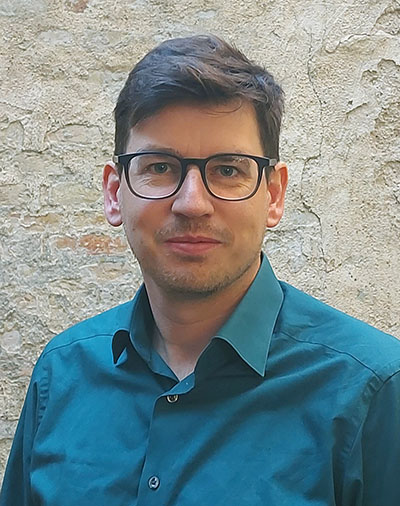
Dr. Daniel Groß
Daniel Groß is curator and research coordinator at Museum Lolland-Falster. His main field of work are wetland archaeology and Stone Age archaeology with a particular interest in human-environment interactions. In his projects he deals with artefact studies, landscape and settlement archaeology and socio-economic change through bridging humanistic and natural scientific approaches.
Daniel studied Pre- and Protohistoric Archaeology at the University of Hamburg and was awarded a PhD at Kiel University in 2014. He worked at the Centre for Baltic and Scandinavian Archaeology and in the Collaborative Research Centre 1266 “Scales of Transformation” in Germany before moving to Museum Lolland-Falster, Denmark, in 2021.
Krüger, S., & Groß, D. (Eds.). (2026). Between Thy and Tübingen. Late Palaeolithic and Mesolithic hunter-gatherer worlds in transition. Studies in honour of Berit V. Eriksen. Sidestone Press. https://doi.org/10.59641/l6o2i3j4k5
Abstract:
This volume brings together twenty peer-reviewed studies honouring the scholarly career of Berit V. Eriksen, whose research has been highly influential in the study of Late Palaeolithic and Mesolithic hunter-gatherers in central Europe and southern Scandinavia. The contributions focus on the Late Glacial and Early Holocene, a time marked by profound environmental, social, and technological transformations that reshaped hunter-gatherer lifeways.
Reflecting both Eriksen’s research interests and current debates in the field, the contributions address a broad range of themes in hunter-gatherer research. These include lithic technology and raw material procurement, long-distance connections and exotic materials, subsistence strategies, burial practices, and aesthetic expression. Several contributions emphasise methodological and theoretical innovation, employing approaches such as geophysical survey, palynology, isotopic analyses, and taphonomic studies to refine chronologies, reconstruct past environments and human-environmental interactions.
Geographically, the volume spans across northern Germany, Denmark, southern Scandinavia, the Baltic region, and adjacent areas, offering case studies that illuminate both regional variability and wider patterns of transition. Particular attention is given to processes of change and continuity, including the emergence of Mesolithic lifeways, shifting relationships between humans, animals, and environments, and the complex responses of hunter-gatherer societies to climatic and ecological challenges. Together, the contributions question linear narratives of cultural development and highlight the diversity and dynamism of Late Palaeolithic and Mesolithic worlds.
Aimed at researchers, students, and readers with an interest in early prehistory, this volume presents new data, innovative interpretations, and critical reflections that advance our understanding of hunter-gatherer societies at the end of the Ice Age and the beginning of the Holocene, while celebrating Berit V. Eriksen’s lasting impact on the discipline.
Contents
Sisterhood in archaeology: Berit Valentin Eriksen as mentor
Sonja B. Grimm, Helene Agerskov Rose, Katrine Balsgaard Juul, Charlotte Damm and Inger Marie Berg-Hansen
Technical Practices and Social Dynamics: A Comparative Study of Havelte Group and Federmesser-Gruppen in Late Glacial Northern Europe
Tobias Reuter
Questioning the linear evolution of the Federmesser-Gruppen /Late Azilian lithic assemblages. Insights from Northern Germany and the Paris Basin
Tobias Reuter, Sofiane Bouziane, Mara-Julia Weber and Ludovic Mevel
Taphonomy, stratigraphy, chronology, and settlement choice at the Blätterhöhle – new results and open questions
Florian Gumboldt, Tom Noack, Michael Baales, Jörg Orschiedt, Wolfgang Heuschen and Andreas Maier
Swiderian sites on the shores of Kalviai Lake, southern Lithuania
Tomas Rimkus
From Ice Age to Insight: The study of the Ahrensburg Tunnel Valley through time
Moiken Hinrichs and Katja Winkler
Not just red. Identification of red Heligoland Flint by macroscopic and microscopic characteristics
Hauke Jürgens, Sönke Hartz and Joachim Schönfeld
The colour of magic: exotic raw materials, prospecting, and the Late Palaeolithic of northern Europe
Felix Riede
‘Lyngby axes’ from Ahrensburg (Schleswig-Holstein, Germany) – Supplementary material
Éva David
Active and passive seismic measurements for mapping and investigating kettle holes: an example from Tyrsted (Jutland, Denmark)
Erica Corradini, Stine Detjens, Manuel Zolchow, Martin Thorwart, Nina Kallinich and Wolfgang Rabbel
Green shadows beneath the waves – a speculative vegetation survey of Doggerland during the GS-1
Sascha Krüger and Benjamin R. Gearey
Isotopic niche partitioning between reindeer and horse in Northwest Europe during the Final Upper Palaeolithic
Dorothée G. Drucker
Looking for diachronic patterns in Danish Mesolithic diets
John Meadows and Anders Fischer
Becoming Mesolithic. Reflections on the mesolithisation in southern Scandinavia and northern Germany
Mikkel Sørensen
Sticks, Stones and Bones. Recent Early Mesolithic finds from Lolland, Denmark
Daniel Groß, Peter Deichmann, Sandra Söderlind, Ulrich Schmölcke and Bente Philippsen
The Northwest-German Mesolithic gap and how to fill it – A survey for water-logged Mesolithic sites
Svea Mahlstedt, Annette Siegmüller, Martina Karle and Steffen Wolters
Hunter-Gatherers in the Sorge River Valley (Rendsburg-Eckernförde district) – A Mesolithic Settlement Hotspot in the 7th millennium BCE in northern Schleswig-Holstein
Sönke Hartz, Ingo Clausen and Fynn Rohweder
Engravings, decorations and feathers. Aesthetics at two sites in a Late Mesolithic perspective
Lars Larsson
The fire between life and death: Mesolithic cremation at Hammelev as a ritual transformation
Mari Tõrv
Two lithic sickle blades from the neolithic wooden structure of Bad Buchau-Möwenweg
Julia Goldhammer
Dr. Sascha Krüger
Sascha Krüger is a project researcher at the department of Environmental Archaeology and Materials Science at the National Museum of Denmark. He is a palynologist with a specific focus on Lateglacial and early Holocene vegetation changes, environmental overturns and human-environmental interactions. In different projects he investigates late palaeolithic reindeer hunting grounds, attempts to reconstruct biomes of Doggarland, explores Iron Age reforestation in Denmark and adds to the understanding of Norse economy in Greenland.
Dr. Daniel Groß
Daniel Groß is curator and research coordinator at Museum Lolland-Falster. His main field of work are wetland archaeology and Stone Age archaeology with a particular interest in human-environment interactions. In his projects he deals with artefact studies, landscape and settlement archaeology and socio-economic change through bridging humanistic and natural scientific approaches.
Daniel studied Pre- and Protohistoric Archaeology at the University of Hamburg and was awarded a PhD at Kiel University in 2014. He worked at the Centre for Baltic and Scandinavian Archaeology and in the Collaborative Research Centre 1266 “Scales of Transformation” in Germany before moving to Museum Lolland-Falster, Denmark, in 2021.
-
Digital & Online access
This is a full Open Access publication, click below to buy in print, browse, or download for free.
-
Buy via Sidestone (EU & UK)
-
Buy via our Distributors (WORLD)
For non-EU or UK destinations you can buy our books via our international distributors. Although prices may vary this will ensure speedy delivery and reduction in shipping costs or import tax. But you can also order with us directly via the module above.
UK international distributor
USA international distributor
- Browse all books by subject
-
Search all books
We will plant a tree for each order containing a paperback or hardback book via OneTreePlanted.org.
You might also like:



© 2026 Sidestone Press KvK nr. 28114891 Privacy policy Sidestone Newsletter Terms and Conditions (Dutch)